NAMING METHODOLOGY GUIDE
How to Blend Two Names Into One
A step-by-step framework for combining two names into a readable, pronounceable shortlist while preserving recognizable roots from both originals.
Blending two names looks simple until you try to create a result that is readable, memorable, and clearly connected to both sources. Cutting each name exactly in half rarely works because names differ in syllable count, stress pattern, and where vowel-consonant transitions occur.
A stronger process starts by breaking both names into reusable fragments, testing both source orders, and comparing four core joining techniques before narrowing down your shortlist.
1. Define the job the combined name needs to do
The context determines how bold or conservative your cut points should be. A playful couple nickname or gaming duo tag can experiment with clipped syllables, whereas a baby name or commercial brand requires effortless pronunciation and clean spelling.
Decide upfront whether both source names need equal visibility, whether a two-syllable limit matters, and whether the tone should feel warm, classic, modern, or playful.
2. Break each source name into recognizable fragments
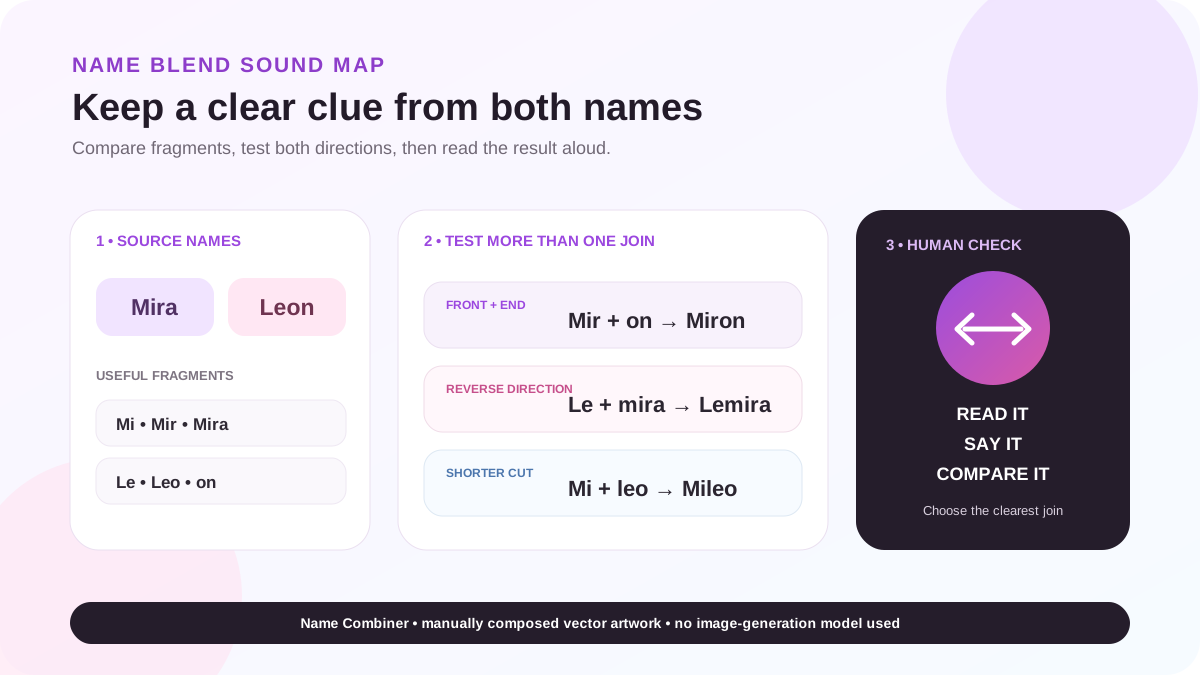
Write both names in their everyday spelling and mark every prefix, suffix, and internal syllable that still reminds you of the original. For example, David yields Da-, Dav-, Davi-, -vid, and -id; Sarah yields Sa-, Sar-, Sara-, -rah, and -ah.
Avoid forcing the same three-letter cut on every pair. A two-letter opening paired with a three-letter ending (Sa + vid → Savid) often produces a cleaner vowel bridge than two three-letter prefixes pushed together.
3. Test prefix-to-suffix splices in both directions
Join the opening of the first name to the ending of the second, then step the cut point forward one letter at a time. With David and Sarah, Dav + ah produces Davah, while Da + rah produces Darah.
Next, flip the order so Sarah leads and David closes (Sa + vid → Savid, Sar + id → Sarid). Reversing the order frequently eliminates awkward consonant collisions without losing either person's letters.
4. Use suffix merging when one opening is distinctive
When one name has an immediately recognizable opening—such as Theo or Elena—keep most of that first name intact and graft a soft ending from the second name (for example, Theo + Amara → Theara, or Elena + Mason → Elason).
Remember that visual identity is not measured strictly by character count: two distinctive letters from a shorter name can carry just as much recognition as four letters from a longer name.
5. Bridge across shared letters and natural overlaps
The smoothest portmanteaus often happen where the end of the first name shares a letter or sound with the beginning of the second. When Mira and Leon meet around their middle vowels and nasals, or when Anna and Alex overlap on A, merging the shared letter avoids clumsy repetition.
If no natural overlap exists in the standard spelling, fall back to clean prefix-to-suffix joins rather than forcing an unnatural respelling.
6. Interlock vowel and consonant segments carefully
Splitting names at vowel-consonant transitions helps prevent four-consonant pileups or triple vowels. Because written English and international names do not always map one-to-one with spoken syllables, treat automated segment splits as candidates to test aloud.
Say each candidate at normal conversational speed and ask a friend to read the written word cold. If they hesitate over where the stress falls, adjust the vowel at the join.
7. Score and filter for readability
A single pair of names can produce dozens of raw combinations. Filtering out strings with triple repeated letters, consonant runs of four or more characters, or unchanged copies of the input names lets you focus on the 15 to 25 strongest candidates.
8. Compare identity balance across your top five
For couple names and baby-name blends, check that both people can clearly spot their contribution in the final word. Our tool cards display the exact source fragments and retained-letter percentages so you can compare balance at a glance.
9. Match your verification checks to the use case
- Baby names: Test the first name aloud with your family surname, check initials, and research cultural or linguistic meanings across the languages your family speaks.
- Business & brand names: Screen finalists in our Word Combiner, then check national trademark registries, company registers, and domain availability.
- Social & gaming handles: Run your blended base through our Username Generator to validate character length and separator rules for Instagram, TikTok, X, Discord, Twitch, or GitHub.
10. Save a balanced shortlist and export
Instead of saving twenty tiny variations of the same cut, star four structurally different candidates—one forward prefix join, one reverse-order blend, one shared-letter overlap, and one compact form. You can save favourites directly in your browser (nameCombinerFavorites) and export them as a `.txt` shortlist from the Name Combiner homepage.
11. Final readability and usability checklist
- Both source names contribute a recognizable visual or spoken anchor.
- The spelling points to one natural pronunciation on the first read.
- No unintended words appear when the name is written in all-lowercase.
- The name works comfortably in its real destination—whether on a birth announcement, welcome sign, profile header, or domain bar.